We want to bring our brands back into spotlight
In recent years, Olbrich, Polytype Converting and Saueressig Engineering have further intensified their collaboration under the Matthews Engineering umbrella and systematically pooled their expertise. At the same time, the long-established brands, with their respective strengths and market positions, remain clearly distinguishable.
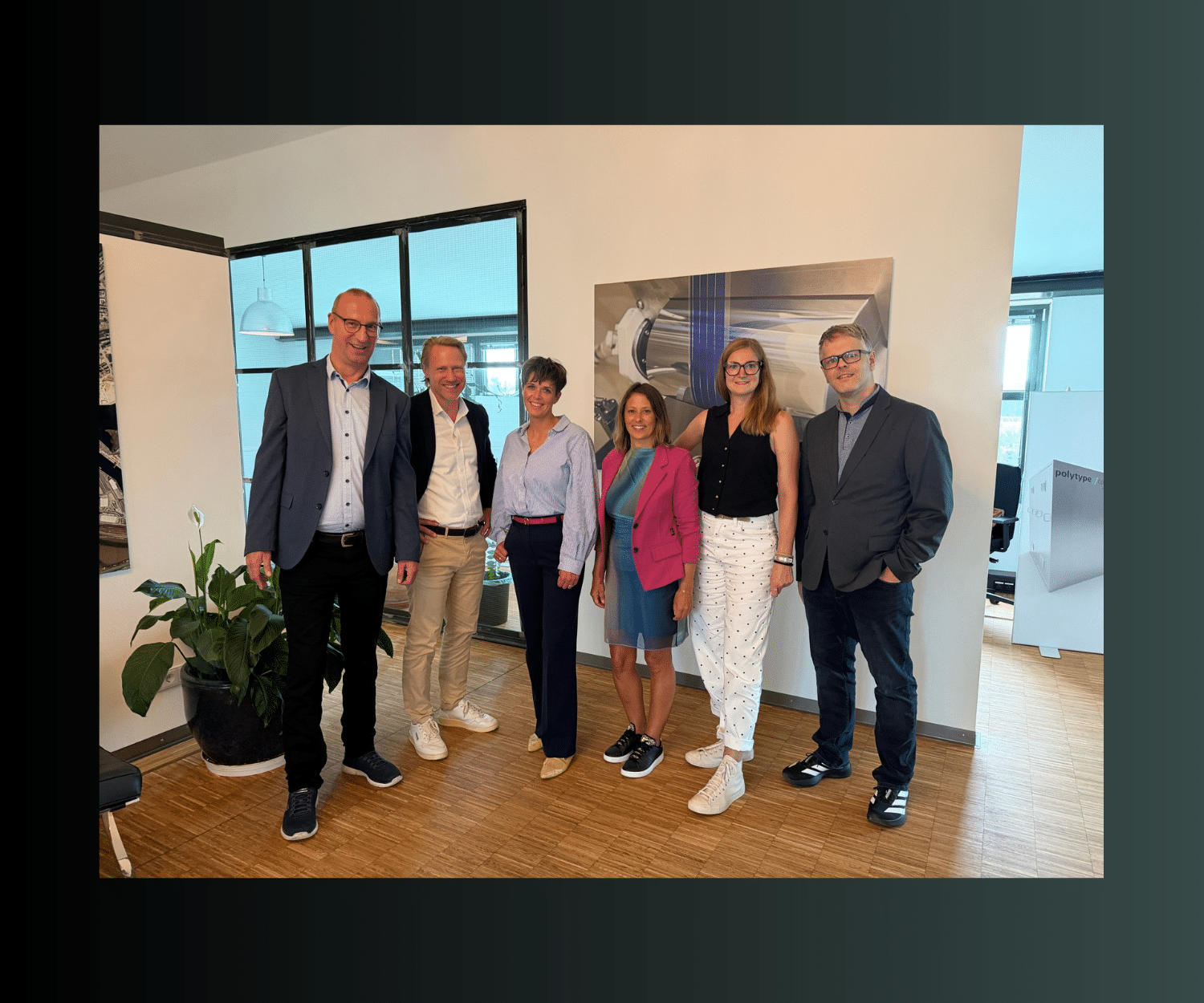
In early September, PRO Flexconvert spoke at the Hamburg office with Esa-Matti Aalto, Senior Vice President / General Manager of the Coating & Converting division, and Stefan Essing, Sales Manager, about the companies’ development, current market trends, technological innovations and the future prospects for mechanical engineering.
PRO Flexconvert:
What role do the various centres of expertise play within your organisation today?
Esa-Matti Aalto:
Our various sites are an important part of our organisation and each contribute specific areas of expertise. In Hamburg, for example, we have many years’ experience in project planning, sales and procurement. Project procurement, in particular, has a long tradition here. In addition, we possess specialist know-how, for instance in the field of drying.
At the same time, the sites now collaborate in a much more closely networked manner. Olbrich in Bocholt and Polytype Converting in Fribourg are no longer isolated units. On projects, different centres of expertise work in tandem. This enables us to make targeted use of our respective strengths and offer our customers a broader technology portfolio from a single source.
PRO Flexconvert:
What does this division look like in practice?
E.-M. Aalto:
Bocholt has traditionally been very strong in decorative applications, such as decorative films, floor coverings and wallpaper, but also in many other applications, such as technical adhesive tapes or in the medical sector.
Fribourg has a clear focus on high-speed machines and systems, such as those used in the labelling and packaging sectors, and possesses extensive expertise in high-precision technical processes.
Added to this is Saueressig Engineering, which complements our portfolio with solutions for embossing and surface finishing, amongst other things. We continue to manufacture machines ourselves. We do not see ourselves exclusively as an engineering service provider, but continue to possess extensive in-house manufacturing and production capabilities.
In the Czech Republic, for example, we have key manufacturing capabilities, including in sheet metal working and dryers. Electrical engineering and other core competencies also remain within our network.
PRO Flexconvert:
The integration under Matthews Engineering has created a new umbrella structure. How are you communicating this to the market as a whole?
E.-M. Aalto:
That is indeed a point we are focusing on intensively. We want to talk to customers primarily about technologies, not about corporate structures. We have therefore concluded that it makes sense to raise the profile of the established brands Olbrich, Polytype Converting and Saueressig Engineering once again.
The overarching link remains the umbrella brand Matthews Engineering and our affiliation with Matthews International Corporation, headquartered in Pittsburgh. However, we want to highlight the heritage and tradition of our brands more clearly. In the European market in particular, these brands have been well-known for decades and stand for specific areas of expertise. We are therefore currently seeing a shift towards a clearer brand identity.
PRO Flexconvert:
What does this mean for the technology portfolio of Olbrich and Polytype?
Stefan Essing:
We see very interesting synergies, particularly in coating and laminating. We have several large pilot coating lines, as well as the relevant plant expertise, in Bocholt and Fribourg.
By combining this with the expertise of Saueressig Engineering, we can also expand our offering in certain coating and finishing processes. A good example is adhesive technology. Particularly when it comes to new adhesive systems, we benefit from our technical centre in Fribourg and the opportunity to develop and test processes in collaboration with customers.
This enables us to integrate chemistry, process and machinery more closely.
PRO Flexconvert:
How do you assess the current situation in the converting industry?
E.-M. Aalto:
The past two years have been characterised by considerable uncertainty. Tariffs, geopolitical conflicts and the resulting lack of predictability have hit the mechanical engineering sector particularly hard.
If a customer cannot reliably plan their own production and capacity utilisation, an investment in a new machine is quickly put on hold. We therefore had to adapt our own organisation to the changed market situation. “Right-sizing” is perhaps the more positive term for this.
Decisions like this are never easy, but looking back, it was the right move. At the same time, I now have a more positive impression of the market again. There is a certain “now more than ever” mentality. Many companies seem to be telling themselves: we cannot wait forever. At some point, investment has to be made, even if the overall conditions remain difficult.
Stefan Essing:
I see it that way too. There are projects that keep getting postponed. At the same time, there are areas where demand is surprisingly robust. For example, we’ve secured a very large order in the traditional decorative sector, including for imitation leather. This also shows that it makes sense to maintain a broad technological footprint.
PRO Flexconvert:
Resilience has recently been a frequently used buzzword in the industry. What consequences does this trend have for a machinery manufacturer?
E.-M. Aalto:
For us, resilience means, above all, flexibility. We must be able to respond to different market developments. This also means not staking all our resources on a single future market.
A good example is the energy sector. A few years ago, expectations for the European battery market were enormous. Today, we are seeing significantly more caution there and, at the same time, considerable overcapacity in Asia.
Europe is currently under considerable cost pressure and, in many areas, can only remain competitive through innovation, quality and productivity.
Matthews, for example, is very well positioned in the field of dry battery electrodes. This technology also plays a role in current developments relating to solid-state batteries. We therefore continue to see considerable potential, even if the market is developing more slowly than originally expected.
PRO Flexconvert:
What role does coating play in this?
Stefan Essing:
A very important one. In Bocholt and Fribourg, we have been working together with customers and within the Matthews network on a process that can significantly increase productivity when coating extremely thin films.
This involves films as thin as a few micrometres, which are coated with ceramics, for example. In one specific process, we were able to increase the speed from around 100 to up to 400 m/min.
For us, this is a very good example of how the expertise within the group can work together. Although the battery market has not developed as many had expected a few years ago, the technological expertise remains relevant, and we are once again seeing interesting signs, particularly in the field of stationary energy storage.
The combination of renewable energies and storage technologies, in particular, will remain an important issue in the long term.
PRO Flexconvert:
Another major issue for the packaging industry is the PPWR. Are you already noticing rising demand for the relevant technologies?
Stefan Essing:
We had initially expected that the new Packaging Ordinance would lead immediately to very strong demand. In fact, we are currently seeing a rather cautious approach.
Many companies do not yet know exactly which requirements will ultimately apply and which technologies they will need. We therefore see a great deal of development work still to be done on the part of our customers. This involves new materials, new coatings and new chemistries. Implementation is consequently proceeding rather slowly.
E.-M. Aalto:
At the same time, we have built up a wealth of experience. We can bring together chemistry, process and machinery, and have pilot plant facilities where new solutions can be developed and tested.
Once regulatory requirements become clearer, we will therefore be well positioned to support customers with implementation. Monomaterials are already relatively well developed technologically.
It becomes more challenging with solutions intended to replace traditional plastics or aluminium. In some cases, the right combinations of materials and processes still need to be identified. We therefore expect this issue to remain a focus for the industry for some time to come.
PRO Flexconvert:
How important is collaboration between the various Matthews brands in this context?
E.-M. Aalto:
That is precisely where one of our major opportunities lies. Olbrich, Polytype Converting and Saueressig Engineering possess complementary expertise.
Saueressig Engineering is strong in the field of embossing and surface finishing. Olbrich and Polytype Converting contribute their respective expertise in coating, drying and lamination.
Historically, these companies have never really competed with one another, but have instead covered different areas. Today, we can combine these areas of expertise much more systematically. This results in a significantly broader range of services for our customers.
PRO Flexconvert:
At the same time, the competitive landscape is changing. How do you assess developments in China in particular?
E.-M. Aalto:
Developments in China must be taken very seriously. I have been travelling there regularly for more than 20 years, and the speed at which the mechanical engineering sector has developed is impressive.
“Local for local” is becoming increasingly important.
In the past, there was practically no alternative to European machinery in many applications in China. Today, there are local suppliers whose solutions are adequate for many applications.
The crucial question is therefore how we justify our technology. It is not just about the purchase price, but about productivity, quality and total cost of ownership.
Stefan Essing:
This also applies to India. In my view, India is one of the most demanding markets of all: technically very sophisticated, yet extremely price-sensitive. There, you have to be able to explain very clearly what economic benefit a machine offers over its lifetime.
PRO Flexconvert:
One area that is also increasingly making inroads into the world of machinery is artificial intelligence. Where does Matthews stand on this?
E.-M. Aalto:
AI has now become part of our day-to-day work. For example, we use Copilot applications and are exploring potential applications in design, process engineering and internal processes.
At the same time, we have our own structures within the group that deal with the topic of AI. At the moment, however, I’m less focused on a single, spectacular AI business model and more on the question of how we can improve existing processes.
One example is the use of existing test data. We’ve carried out a great many tests and projects over the decades. Often, only one member of staff today is aware that a particular test ever took place.
AI can help to find such information more quickly and link it together.
Stefan Essing:
There are also many possibilities within the machine itself. Anomaly detection, web break monitoring and predictive maintenance are not entirely new concepts. However, advances in data processing and AI are opening up new possibilities for these applications.
PRO Flexconvert:
Finally, as you look ahead to the coming months, what will be the focus?
E.-M. Aalto:
We want to further expand our technological expertise for the benefit of our customers, whilst at the same time bringing our traditional brand identities more strongly to the fore.
The market remains volatile, but we are certainly seeing positive signs. We have also learnt that, in such an environment, it is important to remain flexible and be able to serve different markets.
It is precisely this breadth that is a strength of Olbrich, Polytype Converting and Saueressig Engineering.
Stefan Essing:
Technologically, we particularly want to further develop our expertise in coating, drying and laminating.
With our technical centres, in-house production and the know-how of our teams at our sites in Bocholt, Vreden, Fribourg, Hamburg and Holoubkov, we are ideally positioned to do so.
Source: M2N Media / PRO flexconvert NO. 14 – Oct 2026
Image Source: Martin Hirschmann